
Community engagement recap: year in review 25-26
Over the past year, we have received a fantastic response to our Discussion Paper, with community members offering many thoughtful comments about the current state of our democracy, and putting forward fresh ideas on how to improve our democratic practices.
DEM_DISCUSSIONSCOMMUNITY ENGAGEMENT
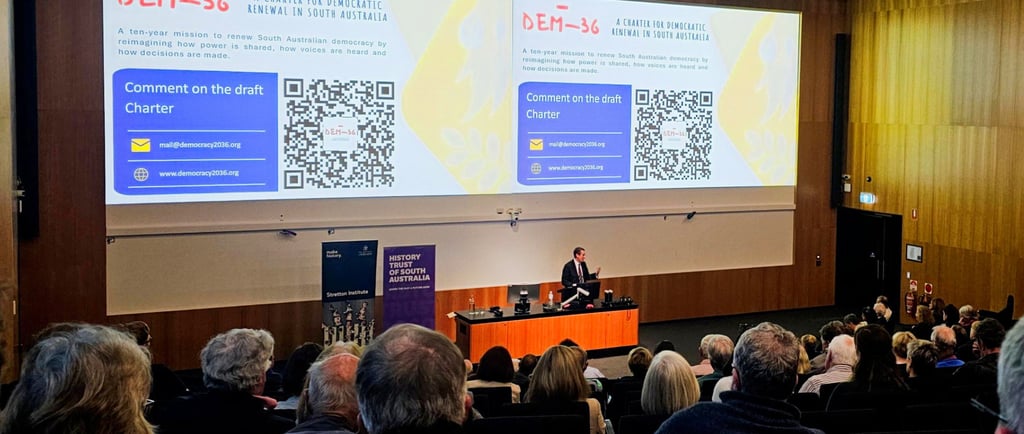
The past year – our first full year as a committee of volunteers – has seen fantastic progress for Dem36. We have developed our guiding discussion paper – Towards a Charter for Democratic Renewal in South Australia, which provides a framework for our community discussions going forward. We have participated in a wide variety of events as presenters and contributors. We have met and held discussions with many stakeholders – including members of the public, community groups, and political representatives. We have developed an issues paper and government submission on the topic of AI. We have been privileged to work with a number of other groups that have a focus on various aspects of democratic reform (and we look forward to continuing our productive relationships that extend the reach of our respective work). And, in conjunction with Adelaide University, we have been hard at work organising the exciting Democracy Innovation Festival, to be held on from 17 to 18 August this year.
The Democracy Innovation Festival brings together leading Australian and international thinkers, policymakers, researchers, students, civic leaders, and community advocates to explore how democratic systems can be renewed to support healthier, more resilient, and more inclusive societies. We encourage you to register and contribute your ideas to the discussions.
Over the past year, we have received a fantastic response to our Discussion Paper, with community members offering many thoughtful comments about the current state of our democracy, and putting forward fresh ideas on how to improve our democratic practices.
Fundamentally, there has been strong agreement that actions need to take place to safeguard and enhance democracy. Feedback has also been positive about the task that Dem36 has set out to achieve, including general agreement about the types of reforms proposed in the Towards a Charter Discussion Paper.
Notably, we are pleased that there is support for our conversations-first approach. Comments received from the public indicate that for any process of democratic renewal to be widely supported and for any proposed solutions to be relevant, we need to first understand what South Australians currently think about our democracy. For similar reasons, there was wide support for the idea of regular democratic audits. As one contributor stated:
“There is a statutory obligation on government to produce a State of the Environment report every five years at state and national levels. Why would the state of our democracy be any less important?”.
It was widely understood that democratic renewal cannot be successful when the voices of some members of our society are marginalised. Supporting the idea of a Human Rights Charter, one commenter affirmed that “Human rights need to be forefront of the constitution”. Another stated that “Full, just and meaningful reconciliation is imperative.”
When we are inclusive in our discussions, we also learn from a much wider range of experiences and approaches. Notably, as one commenter affirmed, there is much we can learn from the experience of South Australia’s First Peoples:
“The thing that stands out most is the value of having a respected process for respectful deliberation. Our western-biased approaches have much to learn from ancient cultures and time honoured rituals and practices (lore) … it would be wonderful for more people to understand and value this wisdom so that we might collectively consider its role in improving our current systems of politics and governance.”
Even when we approach deliberation with the best intentions, there is always going to be disagreement on the best ways forward. Our ultimate task when developing the People’s Charter will be to encourage diverse views, work through disagreements, and take the time to design proposals for change that best harmonise what we have learnt. This is no small task, of course, as sometimes disagreements are in the details, and sometimes they relate to trade-offs between fundamental principles: one commenter, for example, expressed reservations around the concept of freedom of speech, particularly in the current climate of online toxicity and ‘fake news’. These reservations are understandable given the context, and point towards the need to address toxicity and to improve the way democratic discourse happens in the public sphere.
Related to this, digital sovereignty and the AI revolution were raised as issues of concern to contributors. This topic was also the subject of Dem36’s first policy brief and government submission.
Suggestions for reform have included both technical and incremental changes, as well as significant innovations and overhauls. Examples of the former include concerns around proposed changes to the Local Government (Elections) Act that disenfranchise some members of the community who previously had the right to vote, notably non-citizens.
Many emphasise that our present representative parliamentary system, using compulsory preferential voting, has generally served us well and should continue to form the foundation of our democratic system. Nevertheless, all respondents acknowledged widespread concern about the declining levels of trust in politicians, which was considered a key indicator of democratic health. But, as was pointed out, the reverse is also increasingly true – our politicians and bureaucrats are losing trust in citizens. Given this divide between rule makers and rule takers, it is little wonder that many are losing faith in democracy and are disconnecting from the public realm in favour of semi-private online enclaves. This retreat is fuelling division and a tendency to see those with different opinions not as people of goodwill with whom to reason, but as strangers and enemies to be defeated.
The need to reconnect people with democracy is widely agreed. There is a feeling that one vote every few years offers an insufficient level of engagement, and does not enable people to express their nuanced preferences across the wide range of policy issues. As DemocracyCo stated in a submission to us:
“there is an urgent need to increase citizen participation in our democratic system between and in addition to elections”.
DemocracyCo propose innovative forms of engagement, including deliberative democratic processes where people are enabled to reason (not guess), discuss (not debate) and arrive at mutually agreed solutions (not winner takes all). DemocracyCo provides many examples of how deliberative processed can work within and enhance our existing representative and parliamentary processes.
Along these lines, we also learnt about the newly developed Community Capacity Builders’ Active Citizenship for Systems Change Program, which is a pilot initiative designed to train community leaders to be effective change-agents.
It is hoped that by opening up more opportunities for participation, people will be able to exercise their voice and meaningfully influence policy in a way they don’t feel able to currently. When we participate, particularly in our own communities, there is the possibility that we stop seeing each other as strangers, and begin seeing each other as neighbours… even if we still disagree!
Participation is also a practical form of civic education – we learn by doing. A significant amount of our feedback and discussions has been on this issue of civics education and the need to be instructing our young people not only about our democratic processes, but also in the skills needed to be positive and effective leaders in their communities. Civics education is a key focus of Dem36.
At this stage of our community conversations, we particularly encourage ‘blue-sky thinking’, to explore new and innovative solutions. One such proposal was for an enlarged parliament with multi-member electorates. It was commented that as the vote-share of individual parties dips to historic lows, single-member districts are becoming increasingly unrepresentative. Proportional voting for the lower house was also suggested to address this issue.
A number of proposals sought to connect local and state government, with the aim of improving local representation and the voice of communities. The idea was floated, for example, that one council representative (such as the mayor) could represent their community in one of the houses of parliament (giving new meaning to a ‘council house’!). Another idea proposed the reverse, whereby a local council would be made up of the group of lower house representatives elected in multi-member districts.
Unequal distribution of the population was also raised as one of the barriers to political equality in our State, with people in regional areas being so distant from the debates occurring in the City. As one person stated:
“it seems to me that we need a way to ensure that people living outside of these areas are fully heard and enfranchised. Perhaps, just as we have had "Distance Education" we need "Distance Parliament'?”.
Dem36 will continue to workshop these and other proposals that come in to us. We thank everyone who has taken the time to offer their comments and insights over the past year, and we look forward to hearing much more in the year to come – starting with next month’s exciting Democracy Innovation Festival!